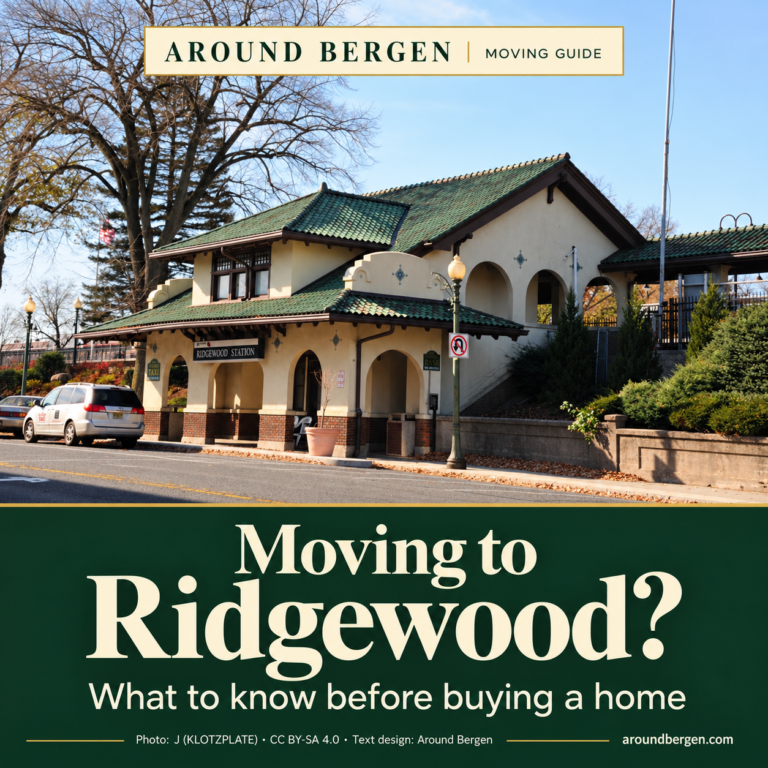
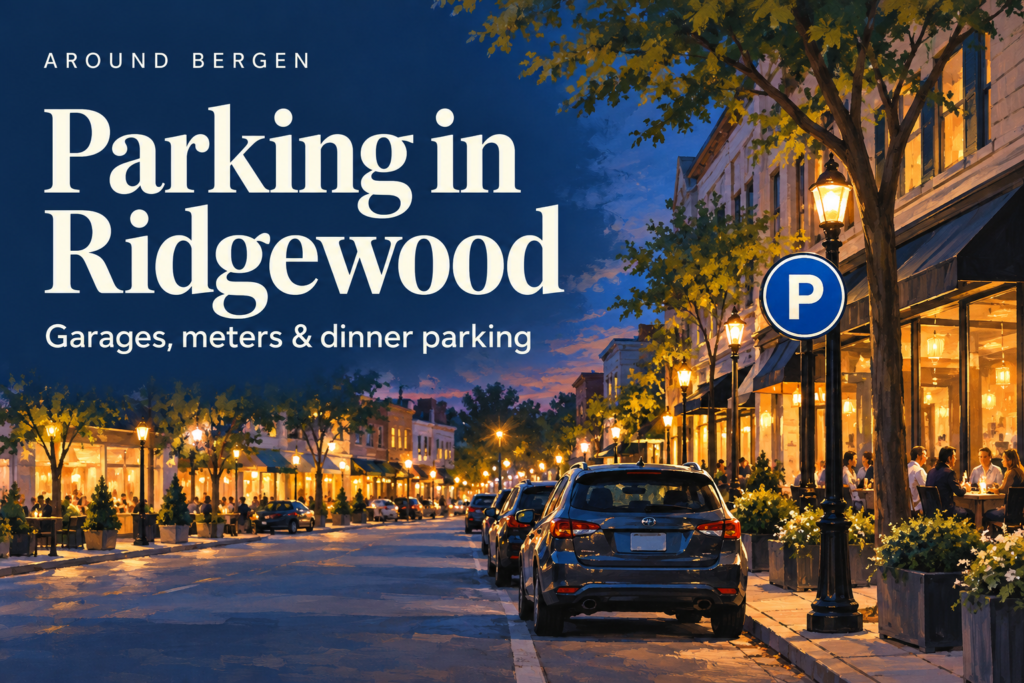
For dinner in downtown Ridgewood, start with the Hudson Street Garage at 25 Hudson Street or one of the village’s general parking lots. Most general spaces have a three-hour limit, and the standard rate is $1.25 an hour during paid parking hours.
The choice gets more specific once you know how long you’ll stay. A short lunch, dinner and a walk, and a full day on the train need different parking plans. Here’s how to choose.
Still deciding where to eat? Our Ridgewood restaurant guide sorts the options by budget, occasion and cuisine.
How much does parking cost in Ridgewood?
The village’s fee schedule sets the standard rate at $1.25 per hour for on-street spaces, municipal lots and the Hudson Street Garage. Two paid hours come to $2.50; three come to $3.75. A mobile-payment vendor fee can be added to the parking charge.
The village lists these general downtown payment hours, unless a location has its own posted rules:
| Day | General paid parking hours |
|---|---|
| Monday–Friday | 9 a.m.–8 p.m. |
| Saturday | 10 a.m.–6 p.m. |
| Sunday | No parking charge |
| Village-listed federal holidays | No parking charge |
Sources: Village fee schedule, § 145-6; Village parking information.
For an evening meal, check the day before paying. A Saturday reservation at 6:30 p.m. falls after the usual downtown payment window; a weekday reservation at that time does not. Reserved-space signs, time limits and overnight rules still need a separate look.
Where should you park in the Hudson Street Garage?
The garage entrance is on one-way Hudson Street. Its first floor is the simplest starting point for a visitor because the village lists general parking there without a permit.
| Floor | What the village currently lists |
|---|---|
| First | General parking; no permit required; three-hour limit. |
| Second | Premium permit before noon; three-hour general parking after noon. |
| Third | Premium or non-premium permit before noon; three-hour general parking after noon. |
| Fourth | Designated for downtown employees and business owners with the required parking arrangements. |
Accessible parking is on the first floor near the elevators. At a garage kiosk, select the floor where you parked before paying.
Source: Village Hudson Street Parking Garage page. Follow the signs for the particular space and day.
What are the other downtown parking options?
The village also lists general parking at the Prospect, Chestnut, Walnut and Cottage lots. In Walnut, leave the spaces designated for downtown employees to eligible users.
Cottage Place is the option to check for a longer visit: the village identifies its lot as the exception to the usual three-hour general-parking limit. Read the space signs before leaving the car, especially where permits or reserved uses are shown.
For a restaurant on the west side of the tracks, the village lists street parking in Garber Square and Wilsey Square among the general options. Read the sign for the individual space; a nearby commuter space can have different conditions.
Source: Village general parking information.
How do you pay, and can you add more time?
Use the meter or kiosk, or ParkMobile where the space allows it. Check that the location and parking details match your car before walking away. Paying for the wrong space is an avoidable way to complicate dinner.
Adding money does not remove a maximum stay. The village code prohibits extending a car’s continuous stay in the same marked space beyond its allowed time, including through a kiosk or mobile-payment service.
Also watch for the special 15-minute spaces. These cost 25 cents for 15 minutes and use their own coin-operated meters. They suit a quick pickup when you can finish within the limit.
Sources: Village payment instructions; fee schedule; §§ 265-38 and 265-39.
Can you use the same spaces for a full day on the train?
Plan a commuter trip separately. A three-hour general space will not cover a working day, and station parking has its own permit requirements.
The village’s 2026 parking-permit application lists premium permits for both residents and nonresidents. Those cover the station’s departure-platform/Station House parking, garage levels two and three, and available Cottage Place spaces. Non-premium permits cover garage level three and available Cottage Place spaces.
Choose the permit for the location you intend to use. Check eligibility and the required annual sticker with the village before relying on a space for an early train.
Does free evening parking mean you can leave the car overnight?
Check overnight permission separately from meter payment. The code generally prohibits parking in public lots from 2 a.m. to 6 a.m., with a specific overnight-permit exception.
That permit system covers designated locations including Prospect, Cottage Place, Wilsey Square and the garage’s second floor. The code limits eligibility to qualifying downtown residents who do not have parking provided by their landlord. The village’s 2026 application gives the permit hours as 8 p.m.–8 a.m.
If you expect to leave the car late or overnight, read the posted conditions and confirm the arrangement before going out.
Sources: § 265-36; 2026 overnight-permit application.
What should you check before leaving the car?
Look for the space’s time limit, any permit or reserved-use sign, and the payment hours. Then check your payment confirmation. Those few details matter more than whether another driver happens to be parked beside you.
For the rest of the visit, explore our Ridgewood stories or compare daily life in our Ramsey or Ridgewood guide.
Sources and updates
Information checked October 26, 2026. Temporary closures and posted restrictions can change a particular space’s availability.
- Village of Ridgewood parking information — general hours, lots, payment and short-stay spaces.
- Hudson Street Parking Garage — entrance, floor use, accessible parking and kiosks.
- Village Code Chapter 145 — parking fees.
- Village Code Chapter 265, Article V — maximum stays, overnight rules and reserved spaces.
- 2026 parking-permit application and 2026 overnight-permit application.