People usually come to Ridgewood for three reasons: the schools, the train and the downtown. Those haven't changed in decades, and they're a big part of why Ridgewood prices keep climbing.
What surprises many buyers is everything else. Many homes are old, some close to a century. Taxes are high, and the way they're calculated is about to change. Some streets near the brooks flood. And the downtown that sold you on the village has its own parking puzzle.
None of this is a reason to stay away. It's a reason to go in with your eyes open. This guide covers the costs, the commute and the practical checks to make before you sign anything.
Ridgewood at a glance
| Measure | Ridgewood |
|---|---|
| Population (2025 estimate) | 26,527 |
| Typical home value (Zillow, Sept. 2026) | $1,255,000 · One of about 20 Bergen towns above $1 million |
| One-year change | +11.6% |
| Five-year change | about +50% |
| Median owner home value (Census, 2020–2024) | $891,200 |
| Median gross rent (2020–2024) | $2,499 |
| Average residential tax bill (2025) | $20,596 · County average: $14,200 |
| Effective tax rate (2025) | 1.944% |
| Owner-occupied share of occupied homes (2020–2024) | 82.5% |
| Median household income (2020–2024, in 2024 dollars) | $208,211 |
| Average work commute, one way (2020–2024) | 34.6 min |
| Public schools | 10, from preschool to Ridgewood High School |
Home prices: what a million buys
Zillow put the typical Ridgewood home at about $1.25 million in September 2026. That's up 11.6% in a year and roughly 50% in five years.
The Census figure is lower, $891,200. It's the median owner-reported home value for 2020 to 2024, a different measure covering a different period. It isn't a measure of today's asking prices or a direct estimate of how much an individual home has gained.
What the houses are like
Much of Ridgewood's character comes from its older homes. You'll find Victorians near downtown, plus Tudors, Colonials and Dutch Colonials on tree-lined streets, along with some postwar ranches and split-levels. Newer homes can also be rebuilds on existing lots.
That character is the appeal. It also means many listings come with old wiring, old plumbing, original windows and basements that weren't built to stay dry. Price in updates, not just the purchase.
Condos and rentals
There are far fewer condos and apartments than single-family homes. Most are close to downtown and the train. About 82.5% of occupied homes are owner-occupied, so the rental market is small. The Census median rent was $2,499 for 2020 to 2024, which is a five-year estimate rather than a current asking-rent quote.
Property taxes: high now, and about to be reset
The average residential tax bill in Ridgewood was $20,596 in 2025, according to the New Jersey Division of Taxation. The Bergen County average was $14,200.
The 2025 effective tax rate was 1.944%. It helps compare towns, but the state says not to use it to calculate an individual property's tax bill. Your bill uses the property's assessed value and the general tax rate.
Why the posted tax rate looks so high
You may see Ridgewood's 2025 general tax rate quoted as 2.890%. Don't panic. That rate applies to assessed value. The state's 2026 county equalization table puts the village-wide assessment ratio at about 60.5% of market value; it doesn't establish the market value of an individual home.
When assessments drift that far from the market, some homes end up paying more than their fair share and others less. That's what a revaluation fixes.
A revaluation is on the way
The Village assessor confirms that Ridgewood is revaluing taxable real estate for the 2027 tax year. Bergen County's list of upcoming revaluations and reassessments also puts Ridgewood in 2027.
A revaluation doesn't raise the village's total tax bill by itself. It changes how that total is split between homes. If a home has been under-assessed compared with its neighbors, its bill could go up after the reset, and if it's been over-assessed, it could go down.
For a buyer, that means the seller's current tax bill may not be a safe guide to the bill after reassessment. Check the property's actual assessment and tax record, and ask the assessor and your agent or attorney how the 2027 reassessment could affect your budget. A purchase price alone doesn't determine the tax bill.
Schools
For many families, the schools are the reason they're here.
Ridgewood Public Schools runs ten schools:
- the Glen School for preschool;
- six K–5 elementary schools: Hawes, Orchard, Ridge, Somerville, Travell and Willard;
- two middle schools: Benjamin Franklin and George Washington;
- Ridgewood High School.
Your address identifies your elementary and middle school zone, but the district says placement is not guaranteed and can change with enrollment and student needs. Some families choose a home just to be near a particular elementary school, so check the district's address list and confirm placement before you fall for a house. Don't take the listing's word for it.
We don't rank schools here. To compare them, use New Jersey's official School Performance Reports, which show test results, class sizes and other measures for each school. Then visit and talk to parents.
Commuting
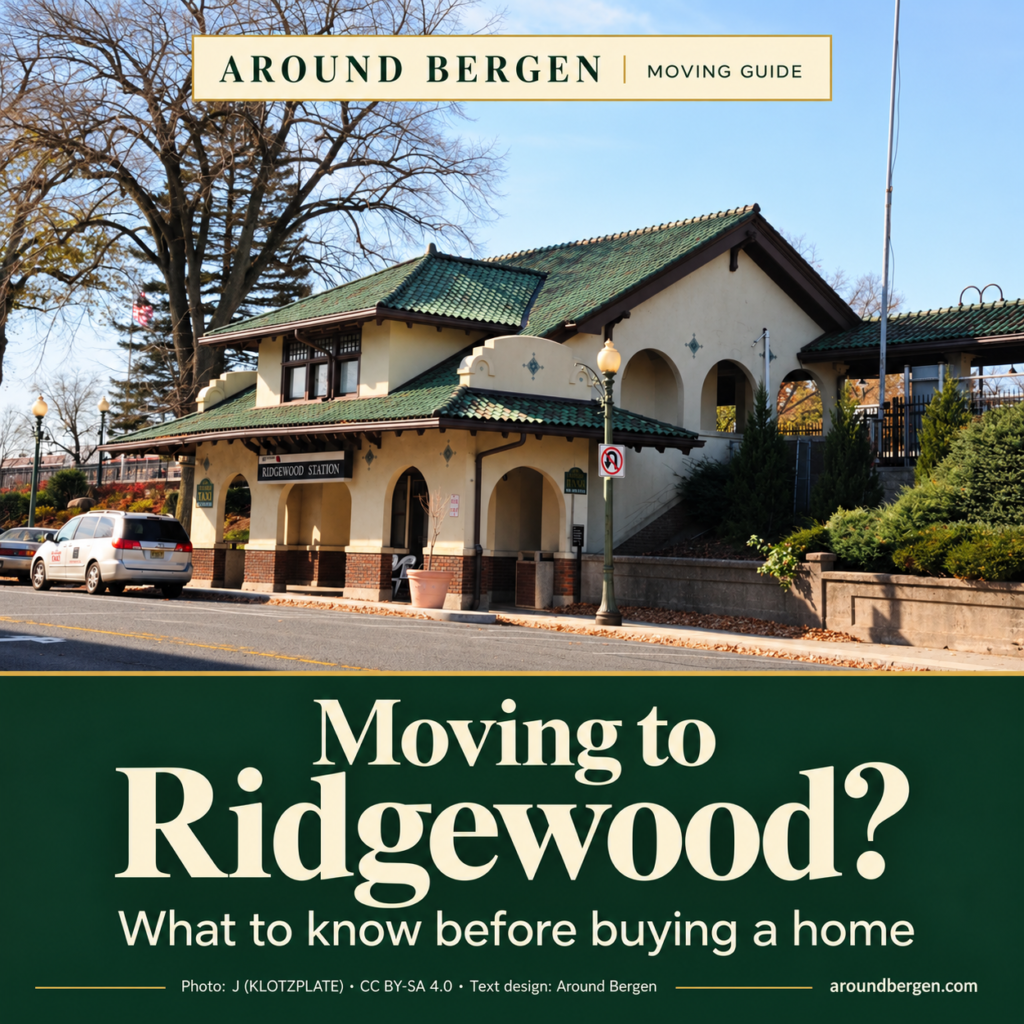
The train is the big draw. Ridgewood station sits right downtown and is served by NJ Transit's Main Line and Bergen County Line. Trains run to Hoboken, and Midtown commuters usually change at Secaucus Junction for New York Penn Station. Check NJ Transit's trip planner for current times, because schedules change.
How you get to the station matters a lot. Commuter parking near the station is limited, and much of it requires a permit. Many residents walk, bike or get dropped off. If you'll drive to the train, check the village's permit eligibility, availability and costs before you buy.
Buses stop near the station and at Van Neste Square, about two blocks away. Several NJ Transit routes connect from there to other parts of Bergen County and beyond.
By car, Route 17 runs just east of the village, and the Garden State Parkway is a short drive away. Ridgewood's own streets are mostly residential, so allow a few extra minutes to reach the highways.
The Census puts the average commute for Ridgewood residents at 34.6 minutes each way in its 2020–2024 estimates. That's an average across workers and travel modes, not a Ridgewood-to-Manhattan train time.
Downtown and everyday life
Ridgewood's downtown, called the Central Business District, is one of the busiest in Bergen County. Ridgewood Avenue, East Ridgewood Avenue, Chestnut Street and the blocks around them are packed with restaurants, cafes, independent shops, salons and services. Many restaurants are BYOB, so dinner out can cost less than you'd expect.
If you live within walking distance, you'll use downtown constantly. If you don't, you'll get to know its parking. Meters run Monday through Saturday, and Sunday is free. The Hudson Street garage is usually the easiest bet.
Village life has a small-town rhythm. Veterans Field hosts big events and summer concerts at the Kasschau Memorial Shell. Graydon Pool, a sand-bottomed village pool, is a summer tradition for members. The public library runs a full calendar for kids and adults.
One more thing: Ridgewood is a village with its own rules, from leaf collection schedules to which home projects need a permit. Read the village website in your first week. It will save you a few surprises.
Before you buy: a Ridgewood checklist
Older homes in a high-priced market reward careful buyers. Here's what to check, beyond the usual inspection.
- Look for an old oil tank. Many older New Jersey homes were heated with oil, and some still have a buried tank, even when the house now runs on gas. Ask for a tank sweep. Removing a leaking tank can be expensive.
- Scope the sewer line. Old clay or cast-iron pipes from the house to the street can crack or fill with tree roots. A camera inspection costs little compared with digging up the front yard.
- Check the wiring and the paint. Homes this old may still have outdated wiring in the walls. Homes built before 1978 may have lead paint, which matters most if you have young children.
- Test for radon. Radon is a concern in parts of northern New Jersey. Ask your home inspector about arranging a test through a New Jersey-certified radon professional.
- Ask about flooding. Parts of Ridgewood sit near the Ho-Ho-Kus Brook and the Saddle River. Check FEMA's flood map for the address. New Jersey sellers must now disclose a home's known flood history and whether it's in a flood zone, so read that form closely. Also ask whether the basement has ever taken on water, even in a home outside a mapped flood zone.
- Look for open permits. Ask the village building department whether applicable permits and approvals for finished basements, additions and new bathrooms were obtained and closed. Your attorney can help check. Unpermitted work can delay a closing or become your problem later.
- Ask about historic status. If the home is a designated landmark or in a historic district, exterior changes may need review first. Find out before you plan a new porch or windows.
- Budget for the tax reset. As covered above, check the property's assessment and current tax record, and ask how the 2027 reassessment could change the bill. Leave room in your budget for that uncertainty.
Frequently asked questions
How much does a house cost in Ridgewood, NJ?
Zillow put the typical home value at about $1.25 million in September 2026, up 11.6% from a year earlier. Prices vary widely by size, condition and street.
How high are property taxes in Ridgewood?
The average residential bill was $20,596 in 2025, compared with a Bergen County average of $14,200. The effective tax rate was 1.944% of market value.
Is Ridgewood having a property revaluation?
Yes. The Village assessor confirms a reassessment for the 2027 tax year. Some homes may pay more and others less afterward, so the seller's current bill may not match yours.
How long is the commute from Ridgewood to New York City?
The Census average of 34.6 minutes is for residents' work commutes across travel modes, not a train journey into Manhattan. Trains run from downtown Ridgewood station to Hoboken, with a transfer at Secaucus Junction for New York Penn Station. Check NJ Transit's trip planner for your actual route and time.
How many schools does Ridgewood have?
Ridgewood Public Schools has ten: a preschool, six elementary schools, two middle schools and Ridgewood High School.
What should I check before buying an older home in Ridgewood?
Ask for an oil tank sweep, a sewer line scope and a radon test, check the flood map and the seller's flood disclosure, and have your attorney look for open permits.
Figures and local guidance checked October 25, 2026. Prices, tax rates and schedules change, so confirm them before you make an offer. This article is general information, not legal or financial advice.
Related Ridgewood and Bergen County guides
Compare Ramsey and Ridgewood, explore our Ridgewood dining guide, or use the countywide guides to property taxes by town and the housing market.
Sources and updates
- U.S. Census Bureau: Ridgewood QuickFacts, 2020–2024 estimates and 2025 population
- Zillow Research: ZHVI data (September 2026 snapshot used in our housing report)
- NJ Division of Taxation: 2025 general and effective tax rates
- NJ Division of Taxation: 2025 average residential statistics
- NJ Division of Taxation: how general and effective rates are used
- NJ Division of Taxation: 2026 Bergen County equalization table
- Village of Ridgewood Assessor: 2027 property reassessment
- Bergen County: 2026–2027 revaluation and reassessment schedule
- Ridgewood Public Schools: schools directory
- Ridgewood Public Schools: address zones and placement qualification
- NJ Department of Education: School Performance Reports
- Village of Ridgewood: parking rules and permits
- NJ Transit: Ridgewood station and trip planning
- Village of Ridgewood: Graydon Pool
- Village of Ridgewood: Veterans Memorial Field and Kasschau Memorial Shell
- Ridgewood Public Library
- Village of Ridgewood: historic preservation element
- Village of Ridgewood: historic preservation permits
- FEMA Flood Map Service Center
- NJDEP: flood risk disclosure requirements
- US EPA: pre-1978 housing and lead disclosure
- NJDEP: radon testing during real estate transactions
- NJDEP: residential heating-oil tank guidance