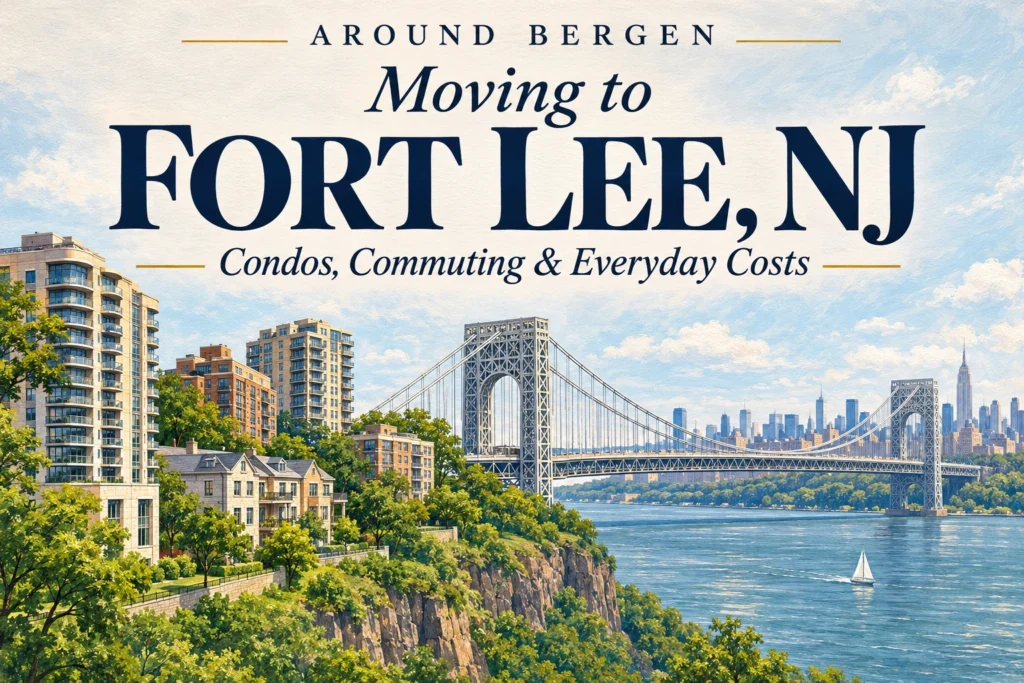
Fort Lee packs a surprising amount into 2.5 square miles. Towering condos sit above the Hudson, the George Washington Bridge is at the borough’s doorstep, and a busy Main Street makes daily errands feel close at hand. For people considering a move, the trade-offs are clear: a faster route to Manhattan and a more vertical way of living, balanced against parking, tolls, monthly fees and a denser pace.
This guide looks at what a Fort Lee move can cost, how the commute works, and the questions worth asking before you buy or rent.
Fort Lee at a glance
- Population: about 40,345 residents (2025 Census estimate)
- Land area: 2.5 square miles
- Typical home value: about $576,000 in January 2026, according to Zillow
- Median owner-occupied home value: $448,000 in the 2020–24 Census estimate
- Owner-occupied homes: 55.4%
- Median gross rent: $2,270
- Average residential tax bill: $12,983; effective tax rate: 1.839%
- Average commute time: 35 minutes
Condos, co-ops and rentals
Fort Lee’s housing story is largely a high-rise story. There are single-family homes and townhomes, especially away from the bridge, but many buyers start with a condo or co-op building. That changes the math: the sale price is only one part of the monthly cost.
Condo or co-op?
In a condo, you buy real property and typically pay property taxes directly. In a co-op, you buy shares in a corporation that owns the building, and the monthly maintenance charge can include the building’s real-estate taxes. Co-ops often have more detailed board approval, financing and occupancy rules, so read the building package before treating two similar listing prices as interchangeable.
Monthly fees matter as much as price
Ask for the current maintenance or HOA fee, what it includes, the latest budget, reserve study and any planned special assessments. Doormen, elevators, pools, garages and bridge-view amenities can be meaningful parts of the monthly bill. A lower purchase price does not necessarily make a building cheaper to own.
Renting
Renters get access to the same bridge-side location and many of the same building amenities without a down payment or a board purchase process. The Census Bureau’s latest multi-year estimate puts median gross rent at $2,270, but individual buildings and layouts vary widely. Look at parking, move-in fees, laundry, package handling and whether utilities are included.
Property taxes and everyday costs
Taxes
Fort Lee’s 2025 average residential property tax bill was $12,983, with an effective rate of 1.839%, according to New Jersey’s Division of Taxation. The bill for a specific home depends on its assessed value, exemptions and the local tax rate. Bergen County also lists Fort Lee among the municipalities scheduled for a 2027 reassessment, so buyers should ask how a property’s assessment may change after a sale.
Everyday costs
- Parking: Some buildings include a space; others charge separately or have waitlists. Street parking can be tighter near the bridge and Main Street.
- Tolls: Drivers should budget for Port Authority bridge tolls and, when applicable, Manhattan congestion pricing.
- Insurance: Condo owners need an HO-6 policy; co-op requirements vary by building.
Commuting from Fort Lee
Fort Lee works best for people who value proximity to Manhattan and are comfortable planning around traffic, transit schedules and bridge conditions. The right commute depends less on a map than on your exact building and work hours.
By bus
NJ Transit routes including the 154, 156, 158 and 159 connect Fort Lee to the Port Authority Bus Terminal. Service patterns vary by route and time of day, so test the walk to your stop and the morning schedule before you commit to a building.
Across the bridge on foot or by bike
The George Washington Bridge’s shared-use path can be a memorable option for walkers and cyclists, but it is not a substitute for a door-to-door daily commute for everyone. Weather, elevation and your destination on the Manhattan side matter.
By car
Car access is the borough’s biggest convenience and its biggest variable. The bridge, Route 4, the Palisades Interstate Parkway and local street traffic can look very different at rush hour. Drive your likely route twice—once in the morning and once in the evening—before counting on a listing’s stated commute.
Everyday life in Fort Lee
Food
Fort Lee has a large Korean community, and Main Street and nearby corridors offer Korean barbecue, soup houses, bakeries, markets and casual restaurants alongside familiar national options. It is one of the strongest reasons the borough feels like a place to live rather than simply a gateway to the bridge.
The outdoors
Fort Lee Historic Park sits along the Palisades with Hudson River views and paths near the bridge. The Greenway and nearby waterfront access add a little room for walking, though Fort Lee is more urban than many Bergen County towns.
A town with a past
Fort Lee’s role in the Revolutionary War is part of its landscape, and its early movie-studio history still gives the town an outsized place in New Jersey culture. The borough’s density and international population are newer layers of the same story.
Schools and community
Families should review the New Jersey School Performance Reports along with a specific school’s programs, enrollment and transportation options. Fort Lee’s population is diverse: Census estimates show roughly half of residents were born outside the United States, and about one quarter are 65 or older.
Before you buy: a Fort Lee checklist
- Compare condo and co-op financing rules before you fall in love with a listing.
- Get the current HOA or maintenance charge, budget and reserve information.
- Ask about special assessments, move-in fees and transfer fees.
- Confirm parking: deeded, assigned, leased or waitlisted.
- Read the building’s pet, rental and renovation rules.
- Drive or ride your real commute during real rush hours.
- Estimate tolls, parking and insurance alongside mortgage, taxes and fees.
- Ask how the 2027 reassessment could affect the property’s tax assessment.
Frequently asked questions
Is Fort Lee a good place to live for commuting to Manhattan?
It can be, especially for people who use buses or value proximity to the George Washington Bridge. The trade-off is that traffic and service patterns can vary, so test your exact route at the hours you expect to travel.
What is the difference between a Fort Lee condo and co-op?
A condo is real property; a co-op is ownership of shares in a building corporation. Co-ops can have more board rules and different financing requirements, and maintenance may include property taxes.
What should I budget beyond the purchase price?
Include monthly maintenance or HOA fees, property taxes, parking, insurance, move-in fees, bridge tolls and any expected special assessments.
Are Fort Lee property taxes changing?
The bill on any property depends on its assessment and the tax rate. Bergen County lists Fort Lee for a 2027 reassessment, so buyers should review assessment details with a local professional.